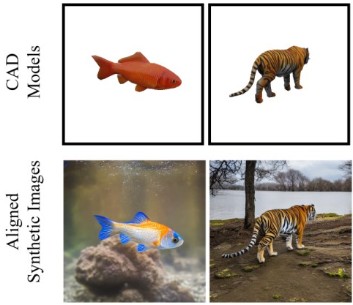
Synthetic data generation has emerged as a powerful tool for improving data scalability in computer vision. Recent diffusion-based pipelines have demonstrated strong photorealism. However, how to enforce precise 3D structure and pose consistency in generated images remains challenging. Existing methods leverage visual prompts such as edge maps to guide diffusion models, but often suffer from over-conditioning artifacts that degrade image realism and limit dataset quality. In this paper, we present a diffusion-based image generation framework that enforces 3D structural alignment while preserving photorealism through adaptive conditioning. Our framework, Adaptive Conditioning for 3D-Aware Synthetic Data Generation (AC3S), introduces a self-supervised visual prompt modulator that dynamically adjusts the strength of ControlNet conditioning, preventing over-conditioning and enabling the diffusion model to retain its generative expressiveness. To further enhance diversity and semantic consistency, we develop a multi-agent vision language model framework that composes detailed and 3D-aware prompts aligned with the underlying geometric structure. Together, these components enable the scalable generation of high-quality synthetic datasets with accurate 2D and 3D annotations. Extensive experiments demonstrate that our method significantly improves image quality and downstream utility.
@inproceedings{ji2026ac3s,title={AC3S: Adaptive Conditioning for 3D-Aware Synthetic Data Generation},author={Ji, Eric and Hu, Q. and Ma, W. and Jain, S. and Li, Y. and Do, M. N. and Liu, Y.},booktitle={European Conference on Computer Vision (ECCV)},year={2026},url={https://arxiv.org/pdf/2606.31204},}
Investigating Dimensional Accuracy and Repeatability of Small Parts Made Using High-Precision Resin-Based Additive Manufacturing
Christopher H. Conway, Weixuan Zheng, Eric Ji, and 5 more authors
In ASME 2026 International Manufacturing Science and Engineering Conference (MSEC), 2026
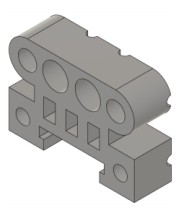
Resin-based additive manufacturing (AM) enables precision manufacturing of small components. Part accuracy becomes critically important for small parts, as part dimensions approach the inherent process limitations. This paper studies the accuracy and repeatability of three resin-based AM processes: Low Force Stereolithography (LFSL), Masked Stereolithography (MSL), and Projection Micro Stereolithography (PSL). We created 60 parts of an electrical connector design in two sizes. There were 10 repeats for each size and process. Every part was imaged using a digital microscope and an automated metrology workflow. Dimensional accuracy ranged from -0.041 mm to -0.115 mm for the large size parts, and -0.011 mm to -0.051 mm for the small size parts. Dimensional accuracy size was +/- 0.1 mm for features at or below 10.5 mm, and deviations increased up to -0.2 mm for larger features. Most deviations were negative, indicating that measured part features were smaller than expected. While some dimensions fall within manufacturers’ specifications, others did not. There were also systematic variations within the expected ranges with unexpected patterns of part shrinkage. Comparing the three processes, we found that PSL has lower accuracy and higher repeatability, while LFSL has higher accuracy and lower repeatability, and MSL was in between.
@inproceedings{christopher2026msec,title={Investigating Dimensional Accuracy and Repeatability of Small Parts Made Using High-Precision Resin-Based Additive Manufacturing},author={Conway, Christopher H. and Zheng, Weixuan and Ji, Eric and Kabir, Hossein and Ferreira, Placid and Do, Minh N. and Tawfick, Sameh and King, William P.},booktitle={ASME 2026 International Manufacturing Science and Engineering Conference (MSEC)},year={2026},address={State College, Pennsylvania},url={https://scholar.google.com/citations?view_op=view_citation&hl=en&user=IcymyOoAAAAJ&citation_for_view=IcymyOoAAAAJ:Zph67rFs4hoC},}
2023
2D-FACT: Dual-Domain Fake Image Detection Against Text-to-Image Generative Models
Eric Ji, B. Dong, B. Samanthula, and 1 more author
In MIT Undergraduate Research Technology Conference (URTC), 2023
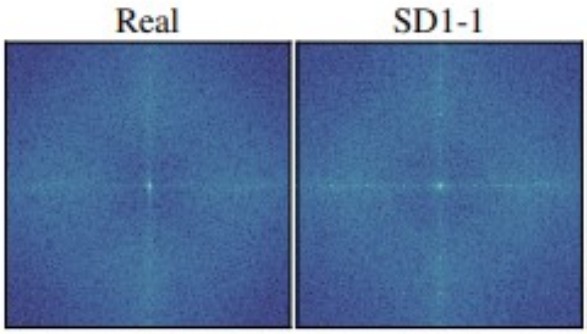
Recent developments in generative artificial intelligence are bringing great concerns for privacy, security and misinformation. Our work focuses on the detection of fake images generated by text-to-image models. We propose a dual-domain CNN-based classifier that utilizes image features in both the spatial and frequency domain. Through an extensive set of experiments, we demonstrate that the frequency domain features facilitate high accuracy, zero-transfer learning between different generative models, and faster convergence. To our best knowledge, this is the first effective detector against generative models that are finetuned for a specific subject.
@inproceedings{ji20232dfact,title={2D-FACT: Dual-Domain Fake Image Detection Against Text-to-Image Generative Models},author={Ji, Eric and Dong, B. and Samanthula, B. and Zhou, N.},booktitle={MIT Undergraduate Research Technology Conference (URTC)},year={2023},url={https://ieeexplore.ieee.org/document/10535000},}
2022
Realistic Simulation Environments to Achieve Visual Servoing on Soft Continuum Arms in Constrained Environments
S. K. Kamtikar, Eric Ji, N. K. Uppalapati, and 2 more authors
In Fourth International Workshop on Machine Learning for Cyber-Agricultural Systems (MLCAS), 2022